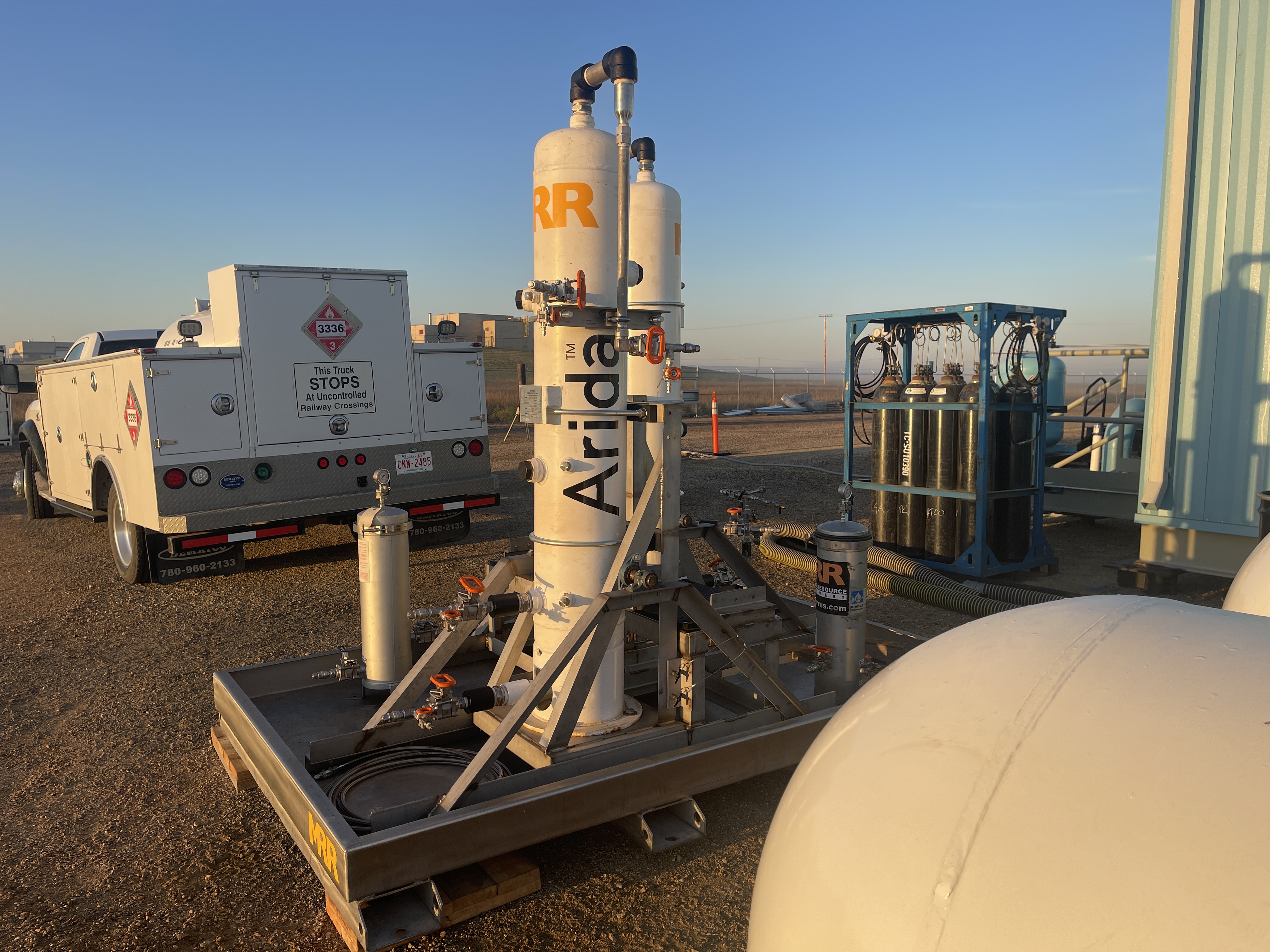
SUMMERSTOWN, Ontario, — Midland Resource Recovery (MRR), a North American provider of natural gas odorization services and technology, today announced the successful field application of Arida™, its process developed to remove moisture from natural gas odorants and return affected product to usable operating condition.
The project, completed for a major Canadian natural gas utility, marks an important milestone in the development and commercialization of the technology.
A Practical Alternative to Disposal and Replacement
Moisture contamination creates real challenges for natural gas operators, particularly in cold-weather environments where water in mercaptan-based odorants can contribute to freezing, operational issues, and unreliable odorization equipment performance. Historically, severely affected odorant has often needed to be removed from service, handled, and replaced.
Arida™ gives operators another option: treat the affected odorant directly, remove the unwanted moisture, and recover the existing product for continued use.
Field Results Validate the Process
During the recently completed project, MRR treated moisture-contaminated odorant using the Arida process. Testing conducted before and after treatment showed a significant improvement in the odorant's low-temperature performance, validating the process under real-world utility operating conditions.
"What makes this milestone important is that we are solving a very practical problem for the industry," said Nick Wiewiorowski, VP of Innovation at MRR. "Odorant contamination can be disruptive, expensive, and difficult to deal with. Rather than automatically treating contaminated odorant as a product that needs to be removed and replaced, Arida creates the possibility of recovering that product and putting it back into service. Successfully demonstrating that process in the field with a major utility is a significant step forward for the technology."
The technology has been developed through a combination of laboratory testing, engineering work, and field validation by MRR's technical team.
Backed by NRC IRAP Support
Development of Arida has also been supported by the National Research Council of Canada Industrial Research Assistance Program (NRC IRAP) as MRR worked to advance the technology from early-stage research through testing and commercialization.
"Innovation in our industry does not always mean building something entirely new," Wiewiorowski added. "Sometimes it means finding a better solution to a problem that operators have dealt with for decades. We are grateful for the support of NRC IRAP in helping us work through the research and validation required to get Arida to this stage."
Beyond reducing the cost and operational disruption associated with replacing affected odorant, MRR believes the Arida process could also reduce unnecessary product disposal, transportation, and waste associated with contamination events.
What's Next for Arida™
Following the successful utility deployment, MRR plans to continue validating the technology across additional operating conditions and expand the commercial availability of Arida to natural gas utilities, pipelines, and other operators throughout Canada and the United States.
About MRR
MRR is a specialized natural gas odorization company serving utilities, pipelines, and energy infrastructure operators across Canada and the United States. MRR provides odorant delivery and transfer, odorization system design and installation, preventive maintenance, pipeline conditioning and commissioning, compliance validation, telemetry, emergency response, and engineered odorization technologies.
For more information, visit OdorizationByMRR.com.
Media Contact: Nick Wiewiorowski, VP of Innovation, MRR — nick@mrrus.com