Mercaptan is flammable. Its vapors form ignitable mixtures with air across a wide concentration range, and the ignition energy required to set those mixtures off is low. A static discharge — from a person's body, from a metal tool, from a hose end contacting a tank fitting at the wrong moment — can carry enough energy to exceed that threshold. Check the product SDS for the specific ignition-energy and flammability data for the blend you're handling; it varies by formulation.
The practice that controls this risk is bonding and grounding. It is one of the most routine procedures in odorant handling and one of the procedures most often performed incorrectly. This article explains the underlying principles. It is not a substitute for your site's written, approved bonding and grounding procedure, which should govern what your crews actually do.
This is a working reference for people who transfer, deliver, and handle mercaptan in tank quantities, to help make sense of why the procedure looks the way it does. The principles apply broadly to other flammable liquids, but the examples here are written for odorant operations.
What bonding does and what grounding does
The two terms are often used interchangeably. They are related but they do different things.
Grounding provides a path for static electricity to flow from a piece of equipment to the earth. A tank, a drum, or a transfer skid can accumulate electrical charge as gas or liquid moves through it, particularly on dry ground. Grounding gives that charge somewhere to go before it builds up to a discharge potential, typically through a dedicated grounding rod or a structural grounding system rated for the purpose.
Bonding equalizes the electrical potential between two pieces of equipment. When two conductive items sit next to each other without being electrically connected, a difference in charge can develop between them. When something — a person, a tool, a stream of liquid — closes that gap, the potential equalizes through a spark. Bonding eliminates the difference before it can discharge. A bonding connection runs between two pieces of equipment, not between equipment and earth.
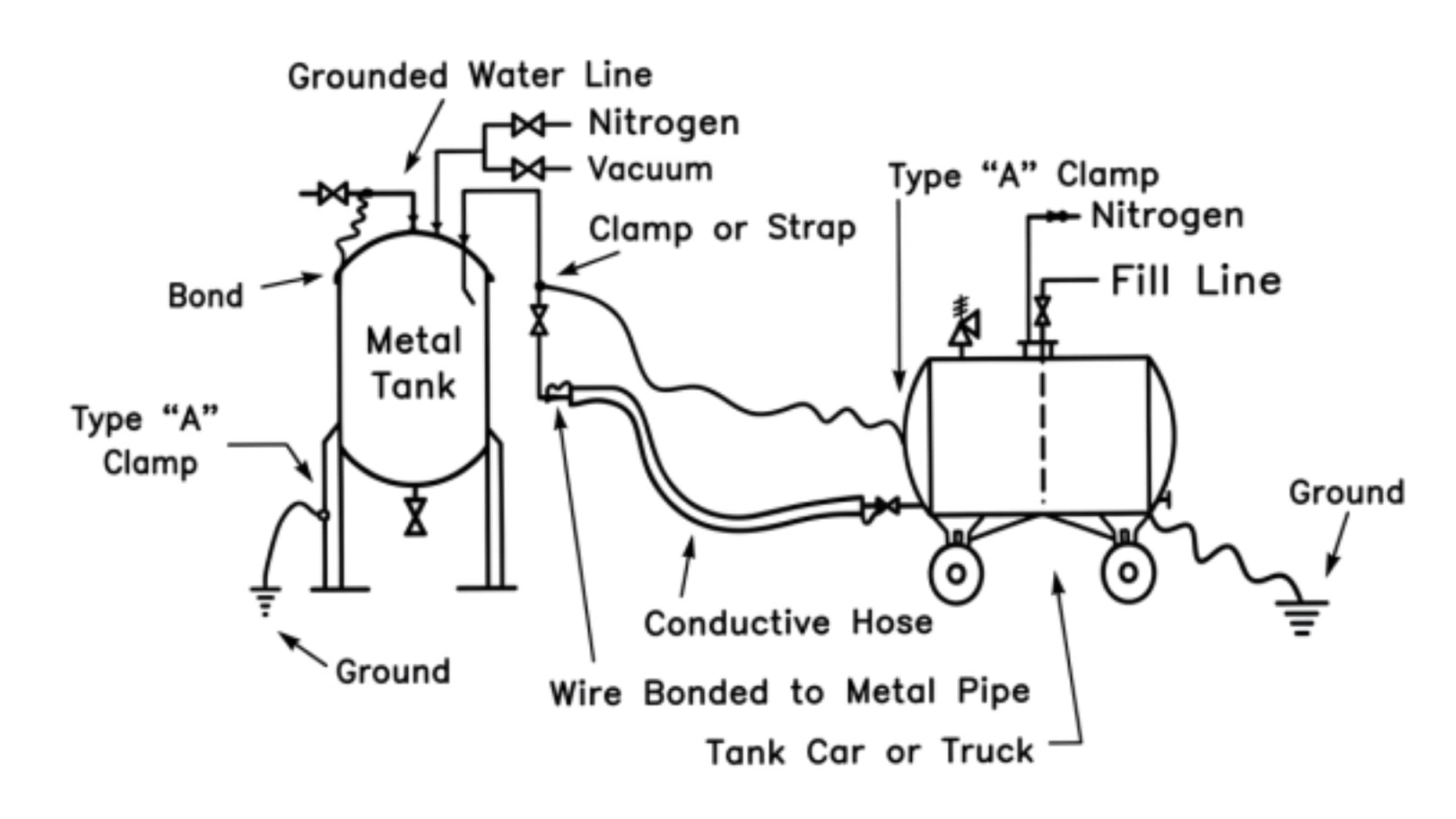
In a typical mercaptan transfer operation, both apply: the receiving tank and the delivery vehicle are each grounded to earth, and the two are bonded to each other, along with the transfer hose, pump, and any intermediate fittings. The goal is a system where every conductive component sits at the same electrical potential, with a path to earth, so static cannot accumulate to a discharge level anywhere in the system.
Where connections commonly fail
A few categories of failure show up repeatedly in the field, and they're worth knowing even if your own procedure already accounts for them.
Paint, coatings, and corrosion at the connection point. A clamp connected through paint or heavy corrosion instead of bare metal can carry meaningfully less current than intended. Identifying a clean, bare-metal contact surface for every connection — and maintaining it — matters more than the clamp itself.
Bonding cables used as grounding cables, or the reverse, or damaged cables in either role. The cables can look similar but serve different functions, and a cable that's been dragged across a yard, run over, or stored uncoiled in weather can have internal damage invisible from the outside. Equipment-specific cables, inspected on a schedule, are the safer answer.
General-purpose jumper cables substituted for purpose-built bonding assemblies. Cables designed for a different job — automotive jumper cables, for instance — aren't engineered or rated for continuous duty bonding flammable-liquid transfer equipment. If they've become the default on a site, that's worth flagging to whoever owns the procedure.
Secondary containers left out of the bonding loop. A truck bonded to a storage tank doesn't cover a smaller container being filled off the same truck. Every conductive vessel in the transfer chain needs to be part of the bonding network, not just the primary endpoints.
Plastic containers and plastic-lined fittings. Plastic doesn't conduct, so bonding a plastic container accomplishes nothing — the static charge on its surface has no path through a bonding cable. Where plastic containers are unavoidable, the applicable procedure needs to address static accumulation directly (controlled flow rate, vapor management, bottom-fill rather than splash-fill), which is a question for whoever designed your site's procedure.
The shape a sound transfer procedure tends to take
Your site's own written, approved procedure governs what your crew actually does — this section is background on why procedures are usually structured the way they are, not a substitute for that document.
Typically, the receiving tank or storage vessel is grounded before other equipment arrives, with the ground connection periodically verified rather than just visually inspected. When a delivery vehicle arrives, grounding or bonding it to the site is usually the first action, completed and verified before any valve is opened. The transfer hose is connected next; some hoses for flammable service include an internal bonding conductor, which (where present) should be verified for continuity before use — where it isn't present, a separate bonding cable is typically required. Transfers are usually run at a controlled flow rate, since higher-velocity fills generally generate more static, and bottom-fill arrangements generally generate less static than top-fill. At the end of a transfer, connections typically come off in reverse order, with bonding cables removed last.
If your site's procedure differs from this general shape, follow your site's procedure — it will have been designed around your specific equipment and conditions.
Cold weather and dry conditions
Static accumulation tends to be worse in cold, dry conditions, since humidity provides a natural discharge path that dry air doesn't. Winter operations in dry climates concentrate higher static risk into months when crews may be inclined to move faster through a procedure — this is a reason to be more careful, not less, about following the site's approved steps. The same logic applies indoors: a heated building with dry air can behave similarly to a dry climate outdoors in terms of static generation.
Static-dissipative footwear can be part of an effective static-control system, but only works as part of a complete, compatible system — for example, paired with conductive or static-dissipative flooring that is itself properly grounded. Footwear alone, on an ordinary floor, does not provide meaningful protection. Follow your site's specific static-control requirements rather than assuming footwear alone is sufficient.
The MRR transfer protocol
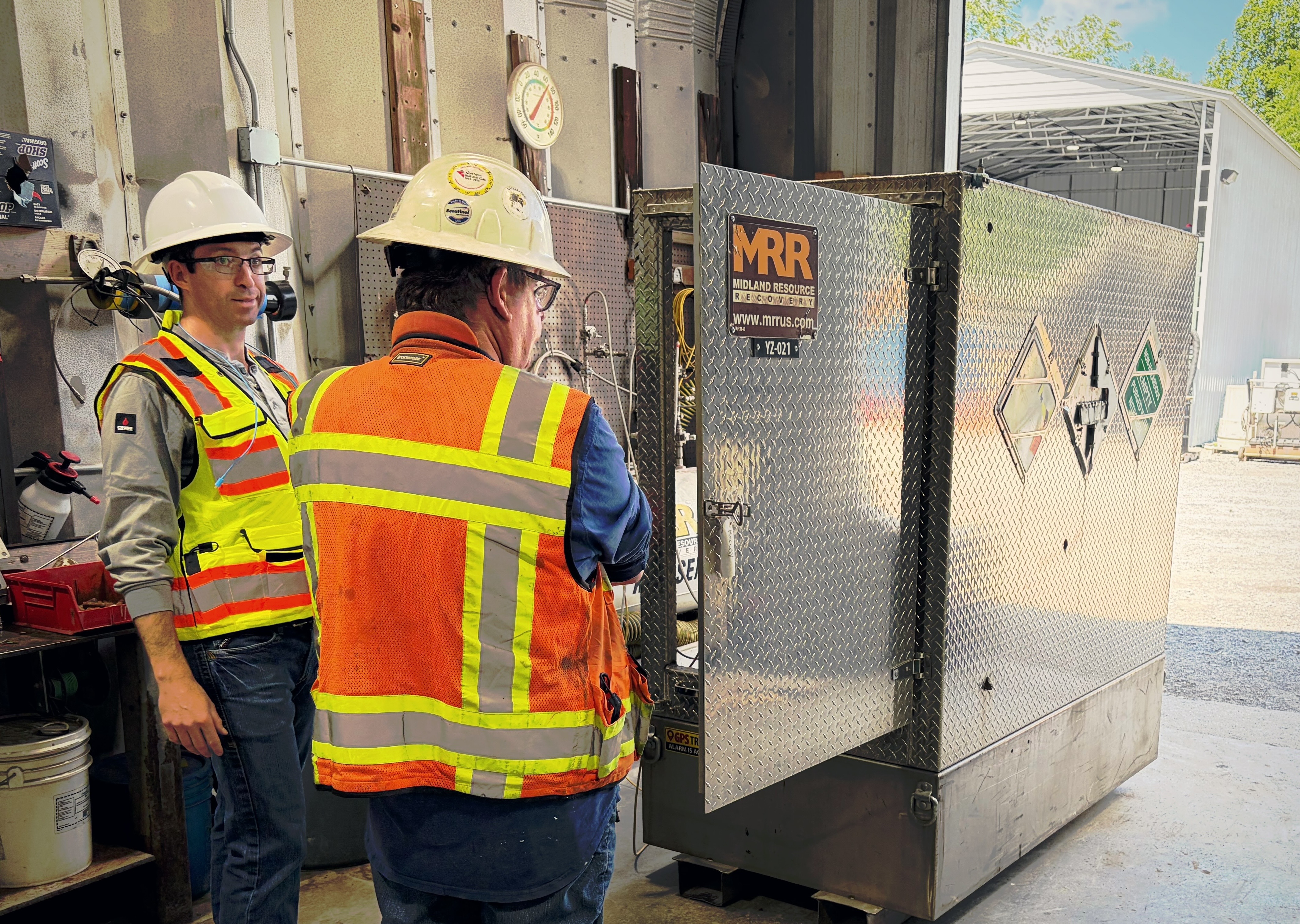
Midland Resource Recovery transfers mercaptan to and from customer sites across North America. Our drivers and field technicians work to a documented transfer protocol, and each transfer produces a record — connections made, continuity verified, flow rate, fill volume, ambient conditions, and the technician who performed the work — that becomes part of the customer's compliance file.
For utility operators, midstream companies, and RNG producers handling mercaptan in tank quantities: follow your site's approved bonding and grounding procedure, the product SDS, and applicable electrical codes. Requirements vary by site and jurisdiction, and your own procedure is the authority, not this article.